
SDG 17: Partnership for the Goals
AU Researcher Wins Prestigious LSE Fellowship to Drive Bioenergy Solutions Aligned with the UN Sustainable Development Goals
- The Australian University (AU) proudly announces that Dr. Jean El Achkar, Assistant Professor in the Petroleum Engineering Department, has been awarded the prestigious Kuwait Fellowship by the London School of Economics and Political Science (LSE). LSE, a globally acclaimed institution recently ranked as the top university in the UK and named the ‘University of the Year 2025,’ is renowned for its excellence in social sciences and policy research.
This highly competitive fellowship, funded by the Kuwait Foundation for the Advancement of Sciences (KFAS), celebrates Dr. El Achkar’s visionary research proposal: “Unlocking Kuwait’s Bioenergy Potential: Integrating Organic Waste Valorization into Renewable Energy and Environmental Policy.” The distinguished judging panel commended Dr. El Achkar’s innovative methodology and the transformative potential of his research to address Kuwait’s critical challenges in energy sustainability and environmental resilience.
Dr. El Achkar will serve as a Visiting Research Scholar at the LSE Middle East Centre from June 1 to September 1, 2025. During this period, his research will focus on utilizing organic waste to produce renewable bioenergy and developing actionable policies to support Kuwait’s energy diversification and environmental sustainability goals.
Expressing his pride and gratitude, Dr. El Achkar stated: “I am happy and proud to receive this prestigious fellowship from such a distinguished institution as LSE. This recognition motivates me to continue contributing to Kuwait’s sustainability journey and to translate my research outcomes into impactful policies that benefit Kuwait and the wider Middle East region.”
The Kuwait Fellowship underscores the significance of fostering research excellence and advancing innovative solutions for regional sustainability. Dr. El Achkar’s selection highlights the international recognition of AU’s faculty and reinforces the university’s commitment to supporting impactful research that drives positive change. - Funded by KFAS, Dr. Jean El Achkar has developed a policy blueprint for bioenergy in Kuwait. The study, set to be published by LSE, provides actionable recommendations to advance renewable energy and sustainability in the country, reinforcing AU’s commitment to innovation and national and sustainable development goals.
- Sustainability – AU
International Collaboration on SDG Data
AU Faculty Participates in LSE Kuwait Conference 2025 on Sustainability and Circular Economy
Dr. Jean H. El Achkar, representing the Australian University (AU) in Kuwait, participated as a panelist at the LSE Kuwait Conference 2025, hosted by the Kuwait Foundation for the Advancement of Sciences (KFAS) and organized in collaboration with the London School of Economics (LSE) Middle East Centre.
Dr. El Achkar took part in a thought-provoking panel titled “Opportunities and Strategies,” alongside Sharifa Alshalfan, Dalal Al Hashash, and moderator Dr. Sara Mehryar. The panel examined how Kuwait can transform challenges in urban planning, waste management, and community engagement into tangible opportunities for resilience, sustainability, and the circular economy.
The session underscored the critical role of collaboration and interdisciplinary approaches in addressing the environmental and developmental priorities outlined in Kuwait’s Vision 2035.
AU Faculty Contribute to International Dialogue on Sustainability at Qatar University
Dr. Jean H. El Achkar, representing the Australian University (AU) in Kuwait, participated in the International Conference on “Empowering Sustainability: SDGs and Future Horizons in the Arab Region,” hosted by Qatar University.
In collaboration with Dr. Mortadha Alsaba, PhD, MIEAust CPEng, Dr. El Achkar presented a paper titled “Sustainability Initiatives Across Higher Education and Research Institutions Toward Kuwait’s Vision 2035.” The presentation highlighted AU’s efforts to embed sustainability within higher education, research, and community engagement, aligning institutional strategies with both the United Nations Sustainable Development Goals (SDGs) and Kuwait’s Vision 2035.
The conference gathered distinguished academics, policymakers, and sustainability leaders from across the Arab region to share innovative approaches for advancing the SDGs. Dr. El Achkar emphasized the pivotal role that higher education institutions play in shaping sustainable futures through research-driven initiatives and cross-sectoral collaboration.
AU actively collaborates with international, national and regional NGOs to tackle the UN Sustainable Development Goals through comparative approaches, student volunteering, applied research, and educational resource development.
- “A Bioenergy Blueprint for Kuwait: Regional Research Insights, Waste Valorization, Feasibility, and Policy Pathways”, addressing SDG 7, SDG 12, SDG 13, and SDG 17 (Partnerships for the Goals). Published last week by the London School of Economics and Political Science (LSE);
- “Optimizing Food Waste Anaerobic Digestion in Kuwait: Experimental Insights and Empirical Modelling Using Artificial Neural Networks” (KFAS-funded project), aligning with SDG 2, SDG 7, and SDG 9 (Q1 Journal).
- “Sustainable Conversion of Petroleum Sludge to Methane: A Study on Anaerobic Biodegradability in Batch and Continuous Systems”, contributing to SDG 7, SDG 12, and SDG 13 (Q1 Journal).
- English Language Program faculty member invited to participate in London International Conference on Inclusive Education (LICIE) 2025, as organized by Center for Inclusive Education (UCL). Representing AU, Dr. Fajer Bin Rashed’s talk is about Exploring Male University Students’ Insights about the Value of Utilizing Picturebooks for Maintaining Inclusive Education, which is closely aligned to SDG4. This goal will be made possible by SDG 17 through providing research collaboration opportunities between the two institutes.
- AU’s 6th Annual Forum focused on the future of higher education in the AI age, addressing accessibility, personalization, and equitable access aligned with SDGs 4, 5, and 9, with active ELP faculty participation (in moderating the sessions and in facilitating a workshop). These goals were facilitated and strengthened by SDG 17: Partnerships for the Goals, as the forum brought together academics, policymakers, and industry experts, including ELP faculty, in a collaborative effort to shape a sustainable and ethical future for higher education.
- English Language Program (ELP) led a visit to NBK Hospital involved reading to children, promoting mental health, literacy, and inclusivity, supporting SDGs 3, 4, 5, and 10. These goals were made possible and amplified by SDG 17: Partnerships for the Goals, through the collaboration between the ELP/AU and Kuwait Association for the Care of Children in Hospital (KACCH). By extending learning beyond the classroom and into healthcare settings, the ELP demonstrates its commitment to community engagement and the values of sustainable development.
- SDG17 is further highlighted in a local partnership between the AU Health, Safety & Security Department and the English Language Program for organizing the “Ripple Effect Initiative.” The initiative incorporated a “Stress Less Fest” to support the students’ mental and emotional well-being during this high-pressure time (aligned to SDG4
- ELP organized a visit to an elderly home, with the aim of offering support and fostering meaningful connections with senior community members. supporting SDG 4. This goal was amplified by SDG 17: Partnerships for the Goals, through the collaboration between the ELP and the elderly home. By fostering meaningful connections with senior community members, the ELP demonstrates its commitment to community engagement and the values of sustainable development.
AU Events and Projects Aligned with SDGs
1. Petroleum Engineering Seminar: “KNPC Role In Climate Change Mitigation”
In support of environmental awareness and cleaner technologies, AU hosted the “KNPC Role in Climate Change Mitigation” seminar. This session highlighted the transition to cleaner energy sources, the adoption of sustainable industrial processes, and the importance of innovation in reducing carbon emissions within the petroleum sector.
2. INJAZ Company Program Orientation and Competition (Project: Ramalah)
The INJAZ Company Program Orientation, which featured AU student participation, emphasized the importance of entrepreneurship in addressing sustainability challenges. Their award-winning project, “Ramalah,” explored innovative solutions for renewable energy storage, demonstrating how creativity and technology can contribute to climate action and energy efficiency.
3. COB Students Organize CSR Initiatives
Further reinforcing AU’s dedication to sustainability, students in the College of Business Management incorporated corporate social responsibility into their coursework. Activities included donation drives, visits to care centers, and awareness campaigns on topics such as breast cancer and smoking. These initiatives showcased efforts to reduce inequalities, support good health and well-being, and promote responsible consumption and production.
Environmental stewardship was also emphasized through beach clean-ups and campus-wide awareness campaigns, which not only fostered environmental responsibility but also encouraged peaceful, inclusive participation and civic action among students.
University Commitment and Alignment with Sustainable Development Goals
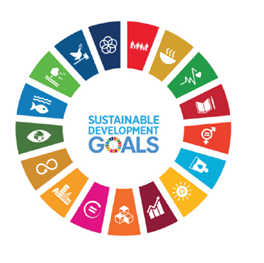
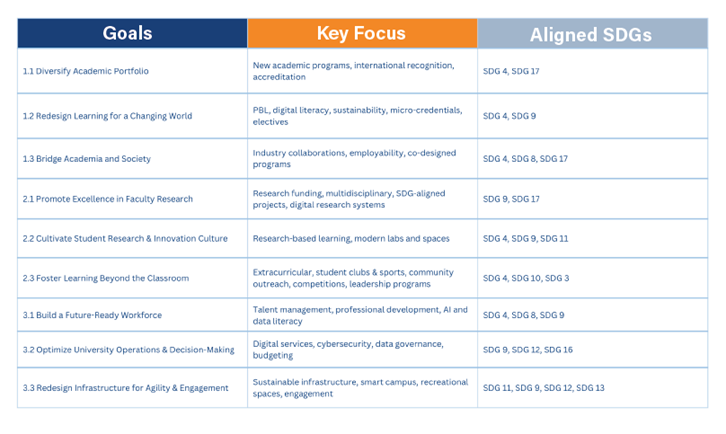
AU strategy (ASCEND) is aligned with the United Nations Sustainable Development Goals (SDGs), particularly in areas of quality education, decent work and economic growth, and industry innovation. The strategy emphasizes adaptive, inclusive, and purpose-driven learning that equips students with real-world skills, digital literacy, and global competencies.
Education for SDG: Specific Courses on Sustainability
AU offers dedicated courses on sustainability that cater to various needs, including full Common Engineering Courses, Departmental Mandatory Courses and Departmental Elective Courses. These courses are designed to equip students with in-depth knowledge and skills related to sustainability and the SDGs.
AU Courses with Sustainable Engineering Practices:
- Courses Outlines for Common Engineering Courses.
- Courses Outlines for Departmental Mandatory Courses.
- Courses Outlines for Departmental Electives Courses.
- The new curriculum for Renewable Energy Engineering (Submitted to PUC).
Dedicated Outreach for the Wider Community: