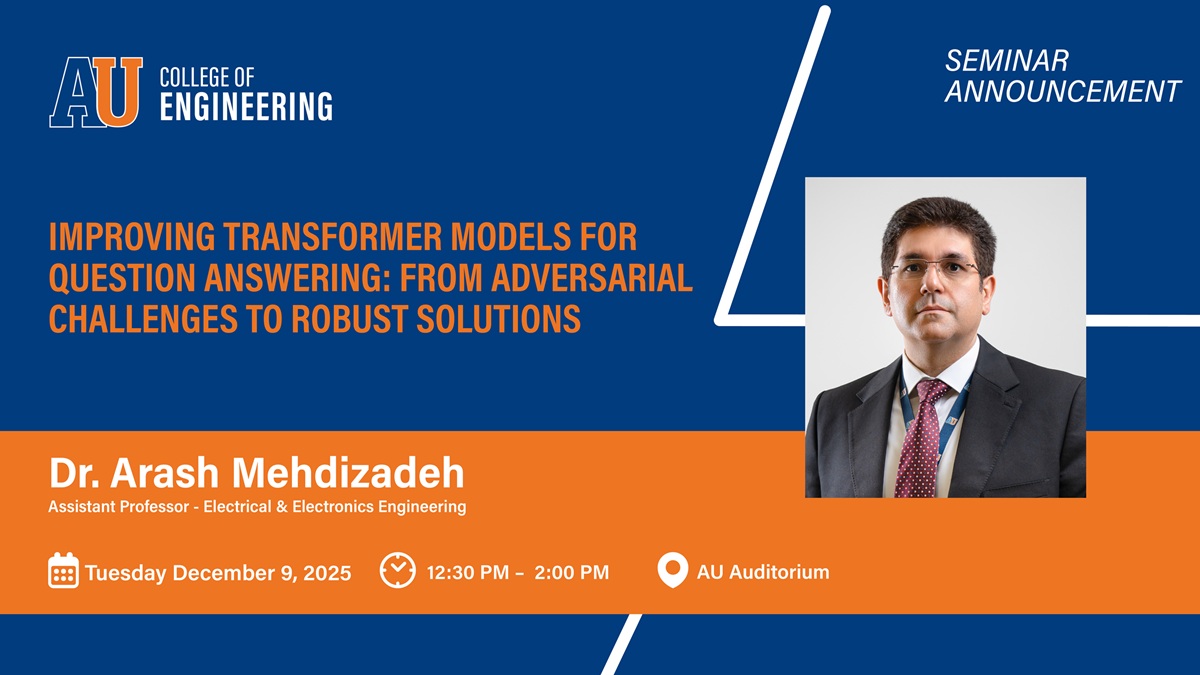
Improving Transformer Models For Question Answering: From Adversarial Challenges To Robust Solutions
About this Topic
Natural Language Processing is broadly defined as the field in which human language is interpreted and processed by computational systems. Within this field, Question-Answering is regarded as a core task of extracting answers from textual information in response to a given query. In this context, adversarial attacks are small, meaning-preserving modifications to the input text that are intentionally crafted to cause incorrect model predictions.
In this seminar, an overview will be provided on how modern machine learning methods have evolved to support such tasks and why Transformer-based architectures have become widely adopted for language understanding. The core topics of this seminar will include:
- Showing how Question-Answering models are affected by adversarial changes
- Presenting evidence of the specific failure patterns that were observed in our research
- Outlining how robustness was improved through targeted retraining and dataset adjustments
Speaker
Dr. Arash Mehdizadeh
Dr. Arash Mehdizadeh is an Assistant Professor in Electrical and Electronics Engineering at the Australian University in Kuwait. He holds a PhD in Biomedical Engineering from the University of Adelaide, an MSc in Computer Engineering, and an MSc in Data Science from The University of Texas at Austin. His work spans artificial intelligence, machine learning, optimization, and biomedical systems. He has conducted applied research in several fields including AI, sustainable buildings and computational biology. He has published widely across these fields and led several funded research projects. He has also played a key role in developing the new computer engineering programs at Australian University (AU). He is a professional member of Institute of Electrical and Electronics Engineers (IEEE), Engineers Australia, and the Chartered Institute for IT.