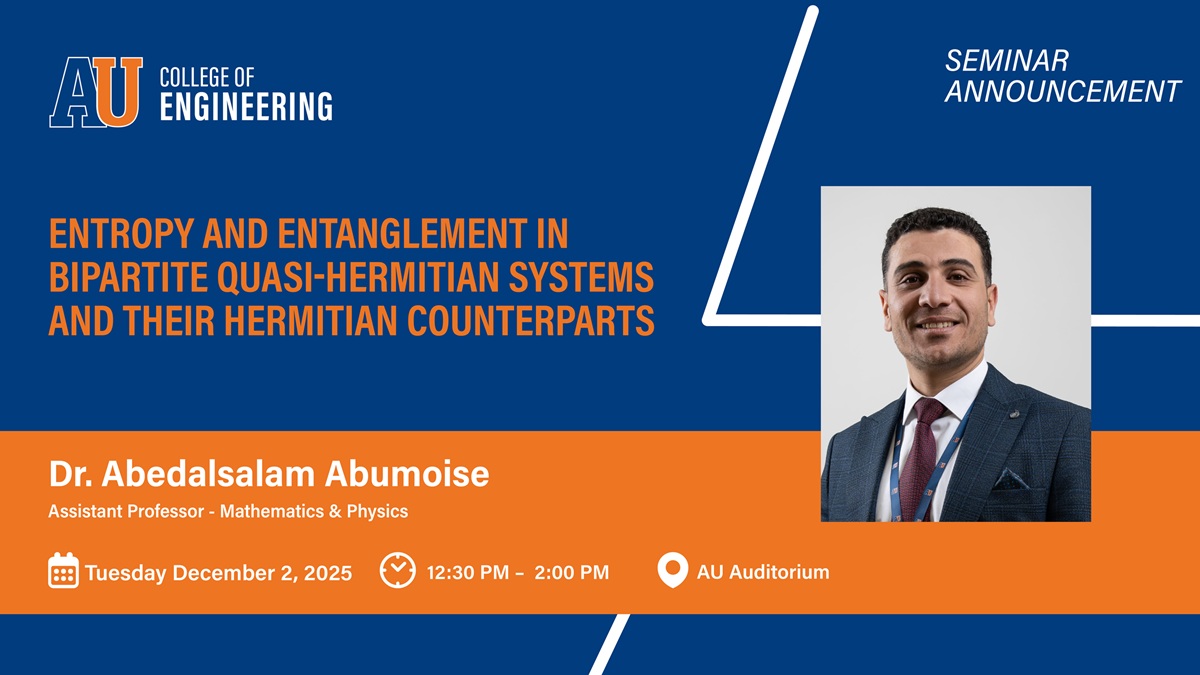
Entropy and Entanglement in Bipartite Quasi-Hermitian Systems and Their Hermitian Counterparts
About this Topic
Speaker
Dr. Abedalsalam Abumoise
Dr. Abumoise is a mathematician specializing in mathematical physics, with a focus on PT-symmetric and quasi-Hermitian quantum systems. He holds a Ph.D. and M.Sc. in Mathematics from Memorial University of Newfoundland and Labrador, where he completed his doctoral studies with a perfect GPA. His research examines the structure and behavior of non-Hermitian Hamiltonians, including entanglement dynamics, diagonalizability at exceptional points, and the role of Dyson maps in defining Hermitian counterparts. In addition to his academic work, Dr. Abumoise contributes to AI development as a mathematical expert, evaluating and refining AI-generated content in advanced mathematics. With extensive university teaching experience across calculus, analysis, and linear algebra, he is committed to supporting student learning and advancing mathematical understanding both in the classroom and through his research.