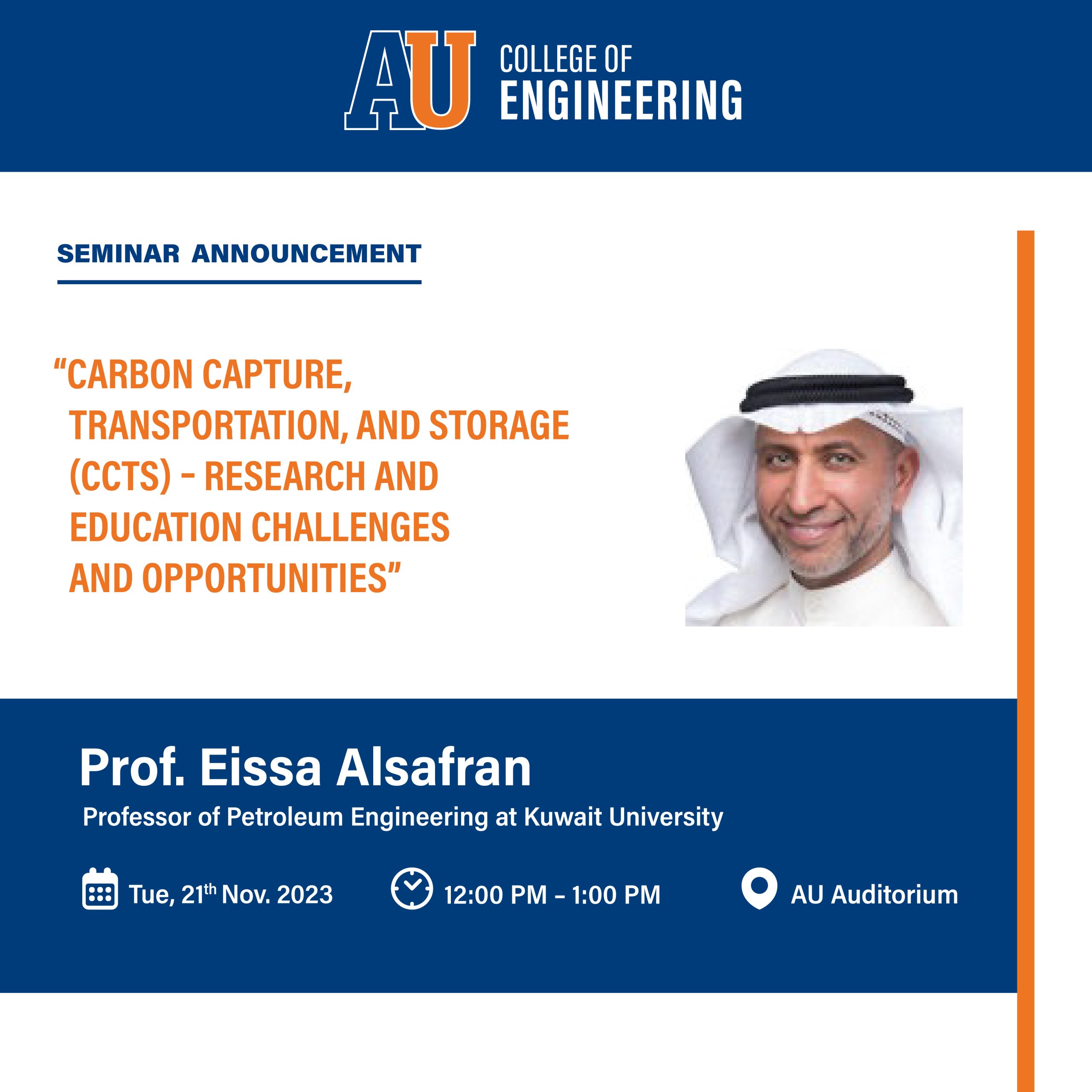
Carbon Capture, Transportation, and Storage (CCTS) – Research and Education Challenges and Opportunities
About this Topic
The CO2 buildup and implications for climate change and its effect on the future of the earth are of great concern to all of us. However, the International Energy Agency (IEA) 2022 Stated Policy (STEPS) and the Shell Sky scenarios, both aggressive decarbonization forecasts, of the world energy outlook show an ongoing, long-term role for oil and gas. Some of the ways the petroleum industry can lead the decarbonization effort include developing and supporting the growth of CCUS, geothermal, and hydrogen technologies through research and education. Therefore, the PE industry is part of the solution and has a major role in energy transition to combat climate change. In addition, petroleum engineers will continue to have relevance and renewed importance in the energy transition because of their unique set of skills and competencies in fluid flow in conduits and porous media that lend themselves to CCUS and geothermal energy extraction. Petroleum engineering, with its unique blend of skills and technologies, is unmatched and needed for a long time.
Speaker
Prof. Eissa Alsafran
Prof. Eissa Al-Safran is a professor of petroleum engineering (PE) and a former vice dean for research and academic affairs at the College of Engineering and Petroleum at Kuwait University. Prof. Al-Safran is currently an adjunct professor of PE at the New Mexico Institute of Mining and Technology (NMT) and was a visiting professor at the Nuclear Science and Engineering Department at the Massachusetts Institute of Technology (MIT), where he taught a graduate course and co-supervised PhD students. He was also a visiting research professor at the PE departments at the University of Tulsa (TU) and NMT. Prof. Al-Safran is the founder and director of the Kuwait University Petroleum Production Int. Collaborative Research Program and co-founder and associate director of the NMT Production and Drilling research consortium. He earned a BSc. (1995), MSc. (1999), and Ph.D. (2003) degrees in PE, and an MSc. degree in mathematics and science education (2003), all from TU. He is the co-author of the SPE book “Applied Multiphase Flow in Pipes and Flow Assurance-Oil and Gas Production,” and has authored and co-authored more than 110 peer-reviewed journal and conference publications.