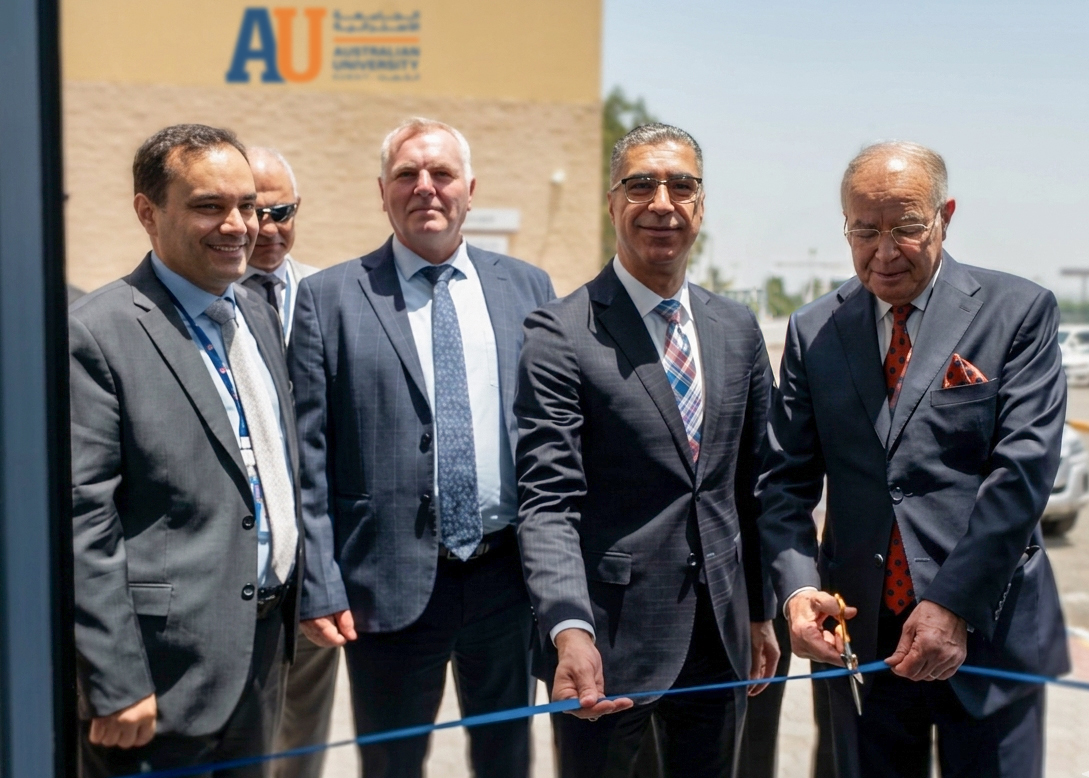
The Australian University (AU) organized the Engineering Graduation Project Exhibition for final-year students during the Spring 2025/2026 semester. The exhibition took place at AU’s campus and was attended by Prof. Isam Zabalawi, President of AU; Eng. Sager Al Sharhan, Assistant to the President for Support Services at AU; in addition to a distinguished group of professors, engineers and academics.
The event showcased the accomplishments of more than 200 engineering students from AU’s different engineering programs. Students presented 50 graduation projects spanning Petroleum Engineering, Civil Engineering, Electrical and Electronics Engineering, and Mechanical Engineering.
The projects demonstrated students’ ability to combine academic knowledge with practical application by delivering innovative and industry-oriented solutions. Many of the projects incorporated advanced and emerging technologies, including artificial intelligence, highlighting the students’ readiness to address evolving industry challenges.
Speaking about the exhibition, Dr. Mohamed Abdul Niby, Dean of the College of Engineering at AU, stated that the event reflects AU’s dedication to equipping students with the knowledge, technical expertise, and practical skills required for the future workforce. He explained that graduation projects play a key role in connecting classroom learning with real world engineering applications.
Dr. Abdul Niby also noted that the quality and diversity of the showcased projects underline the students’ creativity, innovation, and ability to develop impactful engineering solutions that contribute to the advancement of technology and industry in Kuwait.
From his end, Prof. Isam Zabalawi commented on the importance of projects for engineering education, stating: “Institutions such as AU have demonstrated how capstone projects can be positioned as a central pillar of engineering programs. By emphasizing practical relevance, interdisciplinary integration, and alignment with industry challenges, these projects become more than academic requirements, they become platforms for innovation and impact.”